


Taking on cabomba: CSIRO’s tiny weevil tackling a giant problem
A tiny weevil is taking on one of Australia’s worst aquatic weeds: researchers are harnessing nature’s own biological control agents to suppress invasive cabomba, offering a sustainable solution to a highly invasive weed.
It’s work that forms part of the Australian Government’s $5.9 million Future Drought Fund Weed Biocontrol Network for Drought Resilience project, led by CISS.
Cabomba (Cabomba caroliniana) forms dense underwater mats, choking waterways, disrupting ecosystems and threatening water security.
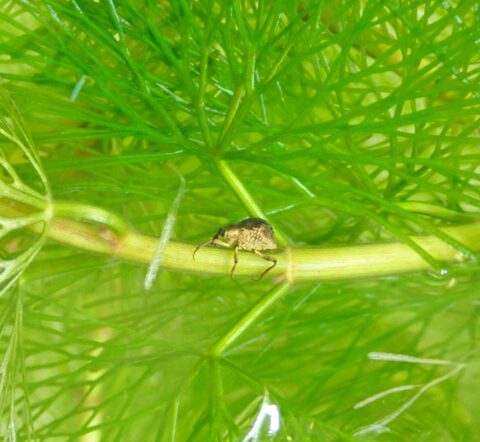
Cabomba weevil. Supplied: CSIRO.
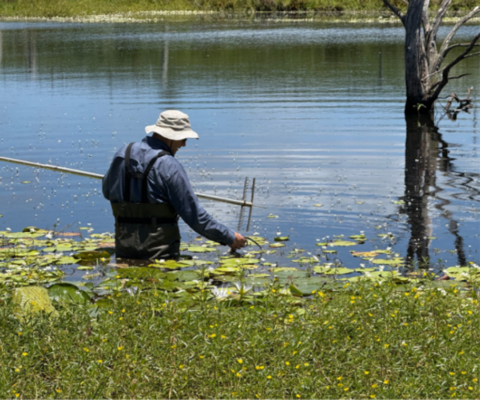
David Officer (NSW DPIRD) sampling water quality, plant biomass and weevil presence at Nana Glen, NSW.
The project is already gaining momentum, with encouraging results. In the first six months:
-
- 33 sites established across Australia
- 1,331 agents distributed
- 170 stakeholders engaged.
The biocontrol agent, Hydrotimetes natans, a stem-boring weevil, is being released at infested sites to suppress cabomba naturally. The program is being delivered by CSIRO in partnership with the NSW Department of Primary Industries and Regional Development (DPIRD), bringing together world-class science and practical, on-ground action.
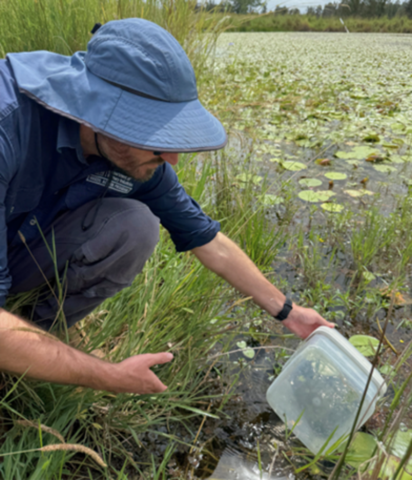
Nathan Pugh (NSW DPIRD) releasing Hydrotimetes natans weevils (Nov 2025) at a Cabomba study site at Glenugie, NSW.
Field releases have taken place across NSW, including at Glenugie and Nana Glen, as well as Queensland, where CSIRO undertook a release at Lake Kurwongbah in partnership with Seqwater. Most recently, Lake Benalla in Victoria became the latest release site, attracting strong local media coverage in the Deniliquin Pastoral Times, WIN News and ABC Radio Goulburn Murray, highlighting the growing community interest in this work.
CSIRO scientists are leading the on-ground rollout of this innovative biocontrol, working with partners across multiple jurisdictions to translate cutting-edge research into practical, long-term solutions for restoring Australia’s waterways.