National investment accelerates weed biocontrol to protect landscapes and productivity
A national effort to support Australia’s drought resilience from some of Australia’s worst weeds is bringing the outcomes of the National Weed Biocontrol Pipeline Strategy | Initial Stage project to reality.
The project identified 20 weed species for investment in its National Weed Biocontrol Investment Report and now, with the Australian Government’s $5.9 million investment in the five-year Weed biocontrol network for drought resilience initiative, evidence-based, sustainable weed biocontrol solutions are rolling out.
Six of the 12 Weeds of National Significance (WoNS) listed in the National Weed Biocontrol Investment Report, and seven weed species overall, are in scope. These are:
African boxthorn (Lycium ferocissimum)
Cabomba (Cabomba caroliniana)
Prickly acacia (Vachellia nilotica)
Opuntioid cacti (several species of cacti including tree prickly pears, Hudson pear, rope pear and snake cactus)
Salvinia (Salvinia molesta)
Sagittaria (Sagittaria platyphylla)
Horehound (Marrubium vulgare) is the final weed species covered by this nation-wide biocontrol collaboration supporting sustainable land management.
Weeds cost Australia nearly $5 billion annually, threatening ecosystems, waterways, and agricultural productivity. Biocontrol uses natural enemies from a weed’s home range and is a cost-effective solution at landscape-scale which delivers an impressive return on investment (ROI).
A CSIRO review found that from an average annual investment of just $4.3 million, biocontrols deliver annual benefits of $95.3 million, with a ROI of $23 for every dollar spent in weed biocontrol research.
The initiative is one of the Australian Government’s Future Drought Fund projects delivering on a commitment to improve landscape function and ecosystem services for drought resilient farms and landscapes. In addition to the $5.9 million Australian Government investment, other financial and in-kind support raises the total project investment to $11 million.
The Centre for Invasive Species Solutions (CISS) is again leading these weed biocontrol efforts via a national weed biocontrol consortium comprising CSIRO, Queensland’s Department of Primary Industries, Agriculture Victoria and NSW’s Department of Primary Industries and Regional Development.
Dr John Virtue, Research, Development and Engagement Director with CISS, says the investment protects Australia’s landscapes but also develops self-sustaining solutions to weed management at a national scale.
“This is such a strong finish for the National Weed Biocontrol Pipeline Strategy | Initial Stage project, transitioning to one of what we hope will be many national weed biocontrol projects into the future.”
“It’s a great recognition of the outstanding work Australia’s leading minds in weed biocontrol and weed risk assessment have put into developing the pipeline strategy to prioritise weeds needing investment.”
“Translating the strategy to on-ground action of mass agent release means Australia benefits from reducing the devastating economic, environmental and social impacts of weeds.”
“The next vital focus will be to build investment for the initial stages of the pipeline – the finding and testing of new biological control agents for other priority weeds. Australia benefits so much from biocontrol and we don’t want the pipeline to run dry.”
The pipeline project started in late 2023 following the release of the National Weed Biocontrol Pipeline Strategy earlier that year. These new efforts are the direct result of the careful and methodical efforts by our National Weed Biocontrol Pipeline Strategy | Initial Stage project partners: CSIRO, Biosecurity Queensland – Department of Agriculture and Fisheries, Agriculture Victoria, and the New South Wales Department of Primary Industries and Regional Development.
Case study: Biocontrol for African boxthorn (Lycium ferocissimum)
The National Weed Biocontrol Investment Report placed biocontrol for this WoNS at Phase III: Mass rearing and release and identified the opportunity for a national release program.
African boxthorn was originally introduced to Australia as a hedge plant. It’s now a highly invasive, drought-hardy species where its widespread distribution, and serious impacts on biodiversity, agriculture, and cultural heritage have elevated its priority status.
Today it’s common in all but the tropical and arid parts of central and northern regions of Australia.
African boxthorn creates dense, spiny thickets which degrade pasture quality, impede livestock access to shade trees and water sources, and reduce vegetation biodiversity.
Traditional control methods such as mechanical removal and herbicide application are costly, labour-intensive, and often impractical in remote or rugged terrain. These challenges make African boxthorn a strong candidate for biocontrol.
As part of the Weed biocontrol network for drought resilience project, African boxthorn is being targeted using the rust fungus, Puccinia rapipes, which was approved for release into the Australian environment as a biocontrol agent to assist with the control of African boxthorn in 2021.
Puccinia rapipes was originally isolated from diseased boxthorn plants in South Africa. Through extensive host-specificity studies undertaken by the CSIRO, the fungus was shown to be highly specific to African boxthorn and cannot damage native Australian vegetation.
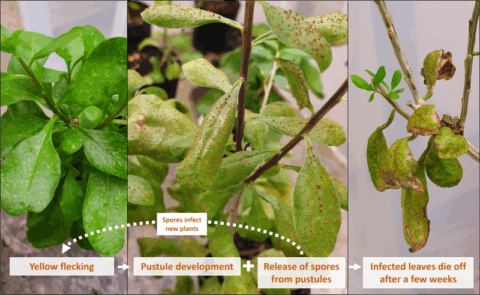
The natural infection process of the biocontrol agent. Image credit: Caroline Delaisse, CSIRO.
Through the new project, CSIRO, in collaboration with Agriculture Victoria, will lead the national rollout of this biocontrol to tackle African boxthorn infestations.
Outcomes will be tracked through a network of monitoring sites, supporting evidence-based evaluation of biocontrol effectiveness and long-term impact with results being shared as the project gets underway.
Information and resources
National Weed Biocontrol Pipeline Strategy | Initial Stage project
Weed biocontrol network for drought resilience – Project
Weeds Australia | Weed biocontrol hub