


30 years on: lessons from calici and the future of rabbit control
Thirty years after the release of Rabbit Haemorrhagic Disease Virus (RHDV), leaders in rabbit management gathered to reflect on one of Australia’s most significant biocontrol interventions – and what it tells us about the long-term challenge of managing invasive species.
CISS CEO, Shauna Chadlowe, RD&E Director, Dr John Virtue and National Feral Rabbit Management Coordinator, Heidi Kleinert, attended the Rabbit Free Australia Annual General Meeting Chaired by Craig Magnussen last month, which marked the 30th anniversary of RHDV’s release in Australia.
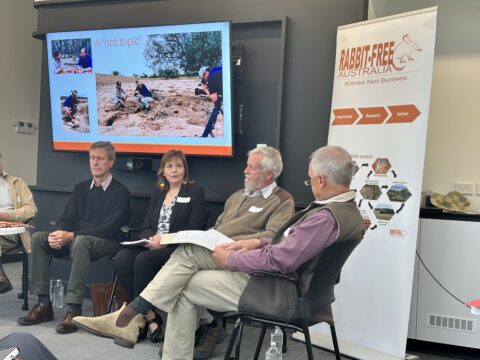
A guest panel at the AGM discussed the 30th anniversary of the release of Rabbit Haemorrhagic Disease Virus (RHDV).
Independent not-for-profit, Rabbit Free Australia, continues to advocate for the sustained investment in rabbit research, development and extension, and on-ground rabbit control in Australia– a message that resonated strongly throughout the meeting.
A highlight of the AGM was a panel discussion reflecting on the origins and impact of RHDV, chaired by Leigh Radford OAM. Panellists Brian Cooke, Nicholas Newland, Rob Morrison and William Morgan revisited the complex approvals process, the early field trials on Wardang Island, the political landscape after the virus escaped to the mainland, and the profound reduction in rabbit numbers that followed.
The discussion also underscored an enduring lesson: while RHDV dramatically changed the landscape of rabbit management, its success depended on continued coordination, monitoring and adaptation – and those requirements remain just as relevant today.
Speaking at the AGM, Shauna Chadlowe reflected on the legacy of the RHDV pioneers and the path ahead. “Thirty years on, rabbit management remains complex and requires sustained, long-term investment. But the groundwork laid by those early RHDV trailblazers has made today’s work possible– and reminds us of what can be achieved when science, policy and on-ground action are aligned.”
The AGM followed the Lessons from the Coorong field tour, led by Heidi Kleinert, which explored contemporary rabbit management challenges and highlighted the importance of local knowledge, collaboration and persistence.
The National Feral Rabbit Management Coordination program receives support from the Centre for Invasive Species Solutions, Department of Agriculture, Fisheries and Forestry, Rabbit-Free Australia, QLD Darling Downs-Moreton Rabbit Board and NSW Department of Primary Industries and Regional Development.
Learn more:
Watch: ABC Landline – Meet the Ferals
Read: Australia’s War on Rabbits – The Story of Rabbit Haemorrhagic Disease